Project · applications
Cronitor
Runtime monitoring system for tracking job execution, failures, and automation health across distributed workflows.
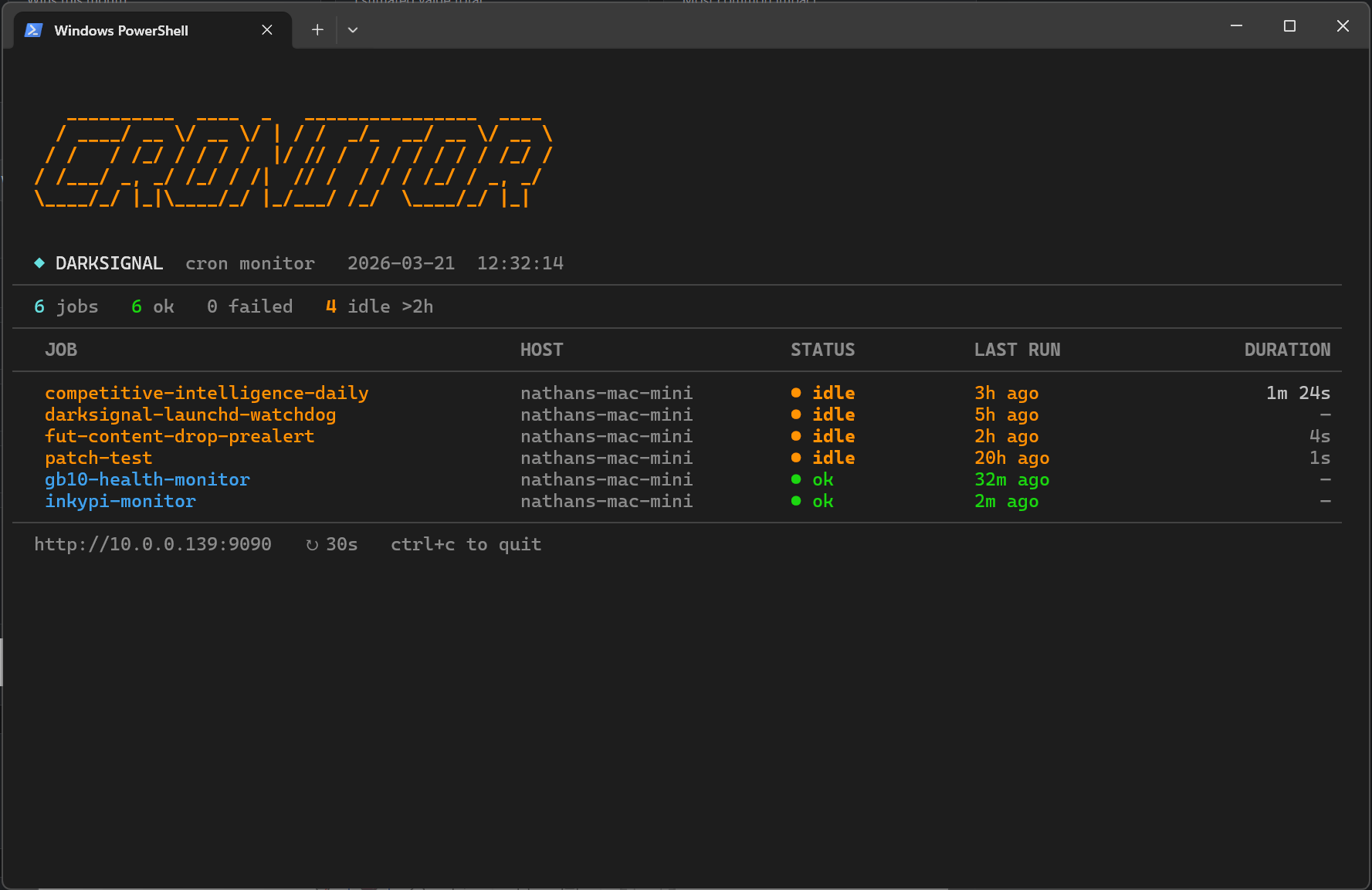
Overview
Cronitor is a runtime monitoring layer for scheduled jobs, recurring workflows, and automation routines across my personal infrastructure. It is designed to surface recent runs, failures, execution health, and operational drift so the background systems powering the rest of the stack are easier to trust, debug, and improve.
Technology Stack
Capabilities
- Recurring job monitoring
- Execution health visibility
- Failure surfacing and runtime tracing
- Health checks across services
- Automated reporting and alerting
- Operational visibility across automation workflows
Implementation
Cronitor is implemented as a modular runtime environment built around lightweight Node services and containerized workers. Scheduling uses native system schedulers combined with coordination logic for dispatch, retries, monitoring, and escalation.
Problem
As the number of services and AI agents in my environment grew, recurring jobs and health checks became harder to reason about. Ad-hoc scripts and disconnected schedulers created inconsistent timing, silent failures, low runtime visibility, and duplicated execution logic.
Architecture
Graph Structure
- User / Trigger Sources: Discord • CLI • scheduled jobs • system events
- Automation Runtime: scheduling • watchdogs • job control
- Agent Jobs: task execution flows
- Health Checks: service + workflow integrity
- Reports / Alerts: anomaly + summary surfaces
- Infrastructure + Services: Mac Mini M4 • GB10 • Pi nodes • app services
- Notification Surfaces: Discord • dashboards • logs
User / Trigger Sources
(Discord • CLI • scheduled jobs • system events)
                    │
                    ▼
            Automation Runtime
     scheduling • watchdogs • job control
                    │
       ┌────────────┼────────────┐
       │            │            │
       ▼            ▼            ▼
   Agent Jobs   Health Checks   Reports / Alerts
       │            │            │
       └──────┬─────┴─────┬──────┘
              │           │
              ▼           ▼
        Infrastructure   Notification Surfaces
        + Services       (Discord / dashboards / logs)
              │
              ▼
     Mac Mini M4 • GB10 • Pi nodes • app services
Sanitized public architecture view of cron-driven execution monitoring and operational visibility.
Outcome
Cronitor adds trust and observability to recurring jobs and background automations by making execution health, recent runs, and failures easier to inspect.
What's Next
- Anomaly detection for job failures
- Deeper metrics integration
- Distributed task visibility
- Cleaner runtime dashboards
Related Projects
AI Agent Orchestration
Multi-model agent environment for tool use, infrastructure interaction, and workflow execution across local systems.
Homelab Infrastructure
Distributed compute fabric for local AI, automation, observability, media workflows, and experimental applications.
Co-Worker
AI-powered sales intelligence system that turns daily signals into account insights, prioritization, and actionable outreach workflows.